Presented by Prove
The Trust 25
Meet the Leaders Defining Trust in the Digital Economy
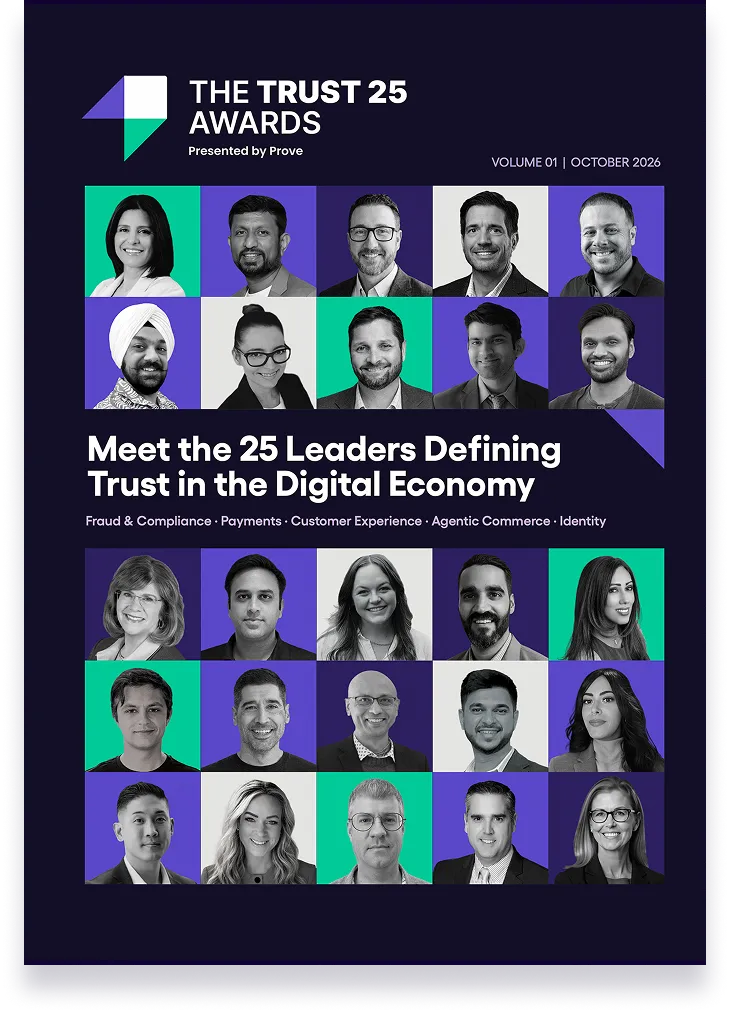
The leaders chosen to be part of The Trust 25 are building the trust infrastructure the digital economy needs as AI is fundamentally changing the speed and sophistication of fraud, while simultaneously beginning to transact on our behalf.
From hundreds of nominations, our independent judging panel selected 25 winners in five categories: Fraud & Compliance, Payments, Customer Experience, Agentic Commerce, and Identity.
We have collected their insights here to offer a look at what’s next for digital trust, the challenges shaping the industry, and the strategies driving progress, directly from the leaders putting them into practice at the world’s leading companies.

The 2026 Trust 25 Winners
Trust is strongest when we build it together. Meet the 25 leaders shaping what trust looks like next.
.webp)

Identity


Senior Director of Risk


For Deniz Ertan, the central challenge in identity is finding the right balance between friction and confidence. Marketplaces need enough certainty to protect their ecosystems, but repeatedly asking good customers to prove themselves can undermine the very trust they are trying to establish.
Her approach is dynamic: use the signals already available to continuously build confidence in the background, then introduce friction only when risk warrants it. As AI makes fraud more scalable while also giving defenders more sophisticated tools, she believes that approach will become increasingly important.


Senior Vice President, Authentication & Identity Product Leader
For Thomas Schraufnagel, the future of identity is less about adding another verification step and more about knowing when another step isn't necessary.
Organizations have access to more identity, behavioral, authentication, and fraud data than ever before. Schraufnagel believes the opportunity is to bring those signals together and use them to make more granular decisions, maintaining confidence in a customer's identity throughout an interaction rather than repeatedly asking them to prove who they are.
The result is a model of identity built around continuous trust: confidence that can strengthen throughout the journey and allow legitimate customers to move with less friction.
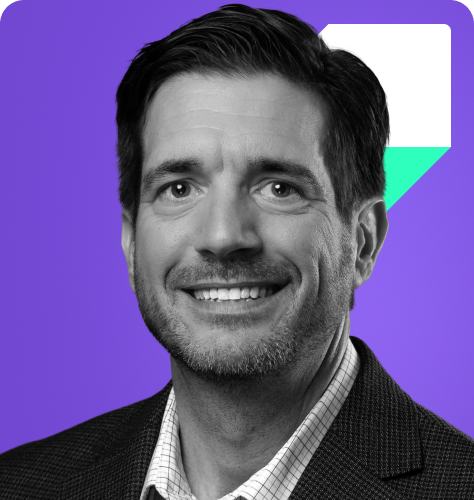
Director, Client Authentication and Identity Verification Technology
Chris Nygard believes identity has a technology problem, but an even bigger migration problem. Stronger authentication methods already exist.
The challenge is retiring security questions, one-time passcodes, and other weak methods still embedded across millions of customer interactions and replacing them at scale, across every channel, without creating unnecessary friction.
For Nygard, that makes orchestration more important than any single authenticator. Identity decisions need to remain consistent whether a customer arrives through an app, contact center, branch, or IVR, and evolve as better signals become available. Because attackers, he points out, will inevitably look for the weakest path.

Director of Product, Acquisition & Onboarding
For Neal Ostrov, identity is bigger than onboarding. As fraud evolves and synthetic identities and deepfakes become easier to create, businesses need to understand identity throughout the entire customer lifecycle.
The opportunity lies in bringing together signals across devices, locations, documents, biometrics, and behavior to create experiences that are both more secure and less intrusive. Neal sees identity not simply as a control, but as a way to make the entire customer experience better.

Director of Engineering
For Manju, the identity industry is confronting a fundamental shift. The rise of generative AI, agentic systems, and non-human identities is making it harder to determine who—or what—is behind a digital action.
As Director of Engineering at Uber, Manju sees traditional point-in-time verification becoming increasingly inadequate for that environment. His vision is identity as a dynamic foundation for digital trust: continuously evaluating signals and adapting as risk changes, rather than assuming an identity established at the beginning of a relationship remains trustworthy forever.

.svg)

Payments

Engineering Leader, Identity
As Engineering Leader for Identity at Stripe, Manpreet Singh is thinking beyond today’s payments to the trust infrastructure that makes digital commerce possible. He is focused on a fundamental question: how do you establish identity when an AI agent may be interacting or transacting on someone else’s behalf?
Singh believes static credentials and one-time verification won’t be enough on their own for that world. Identity systems will need to become more adaptive, connecting people and their authorized agents over time while responding as risk, behavior, and context change.

SVP, Fraud Analytics and Innovation Leader
Kate Zakharava works at the intersection of payments, analytics, fraud prevention, and customer experience. Her focus is on solving an increasingly difficult equation: protecting customers from more sophisticated threats while preserving the speed and convenience they expect.
Zakharava sees fraud expanding beyond attacks on individual customers. As payments become faster and AI gives bad actors the ability to probe for weaknesses at scale, fraud prevention increasingly requires protecting the entire payments ecosystem—from customer interactions to the processes, controls, and technology behind them.

Senior Director of Fraud Prevention and Detection
Jeff Parker is Senior Director of Fraud Prevention and Detection at AvidXchange, where he focuses on proving that speed and security don’t have to be a tradeoff. In B2B payments, that means knowing not only who is initiating a transaction, but whether they are authorized to act for the business, and whether the money is reaching the intended recipient.
Parker believes the industry needs to move beyond one-time verification. As credentials, contacts, banking details, and risk change, trust must be continually reassessed across the relationship—from onboarding and login to account changes and every payment that follows.

Director of Product, Value Added Service (VAS)
Prateek Khamesra has spent his career working at the intersection of payments, technology, and trust, with experience spanning tokenization, digital wallets, authentication, and now agentic commerce. Before joining Visa, he spent more than six years at Mastercard, where his work included new capabilities for Apple Pay, push provisioning, biometric payments, and installment solutions.
Today, his attention is increasingly focused on what happens as AI agents move from helping consumers shop to actually transacting on their behalf. For Khamesra, that changes a fundamental assumption in payments: a valid credential is no longer sufficient evidence that a transaction should occur. The industry must also establish who authorized an agent, what the consumer intended, and what that agent has permission to do.
Khamesra sees an opportunity to build those principles into agentic commerce from the beginning. The goal isn’t to eliminate every moment of friction, he argues, but to apply the right friction at the right moment—making routine transactions effortless while introducing explicit confirmation when risk, unfamiliar activity, or expanded agent authority warrants it.

US CEO
For Amit Cheela, the future of payments is about building infrastructure capable of moving money reliably across currencies, markets, and payment rails.
As US CEO of BVNK, Cheela leads the company’s North American business. Before joining BVNK, he served as CFO of BlockFi, where he helped scale the company to $15 billion in assets under management. Today, his focus is on a transformation that is moving rapidly from the edges of financial services toward its core: stablecoins as infrastructure for real-world payments.
That mission has entered a new chapter. Mastercard completed its acquisition of BVNK in August 2026, bringing together Mastercard’s global network and BVNK’s on-chain and stablecoin infrastructure. The combined capabilities are intended to connect fiat and digital currencies across use cases including cross-border B2B payments, payouts, settlement, and treasury flows.
For Cheela, the opportunity is ultimately bigger than stablecoins themselves. As stablecoins and AI become more deeply embedded in payments, the industry will have to make increasingly sophisticated technology feel dependable and understandable to the businesses and people relying on it.

Customer Experience

VP, Digital Product Management Lead
Customers have been conditioned by an on-demand world. They expect personalized offers, pre-filled applications, instant decisions, and immediate access, and increasingly see that level of convenience as the baseline rather than the exception.
Michelle Malish believes the next generation of customer experience has to deliver on those expectations without asking customers to trade away security, privacy, or transparency. In credit acquisition, that means taking complexity out of the application journey while still giving people confidence that their identity and personal information are protected.

Head of Product, Consumer, Transaction Risk & Credit Risk Platform
As a leader in Product at PayPal, Harsh Dev focuses on making trust an enabler of exceptional customer experiences, not an obstacle to them. For Dev, the standard should be a premium experience: fast and seamless when everything is working, with meaningful support when something goes wrong.
That philosophy shapes how he thinks about risk. The best risk systems operate quietly in the background, using high-quality signals to establish confidence without interrupting legitimate customers. When confidence can’t be established, transparency becomes essential.

Director of Product Management
Regan Huisman Bryant doesn't believe the best customer experience is necessarily the one with the least friction.
In regulated industries like gaming, companies have to ask customers for detailed identity and personal information. For Regan, the more useful question is whether that friction respects the customer, whether people understand why they're being asked for something, believe it serves a purpose, and receive something valuable in return.
That makes onboarding more than a compliance exercise. It's one of the first opportunities a company has to demonstrate that it will handle a customer's information responsibly and design the relationship around their interests.

VP, Acquisition Fraud Strategy
Derek Lanni is VP of Acquisition Fraud Strategy at Synchrony Financial, where he focuses on a challenge at the heart of customer experience: how do you protect people without making legitimate customers feel like suspects?
Lanni believes the answer isn’t eliminating every verification step. It’s understanding the threats that matter, applying the right controls, and creating friction only when it serves a purpose. As AI makes fraud more convincing and scalable, that balance between protection and experience will become even more important.

CXO
For Naaz Nichols, customer experience starts with one thing: earning trust. At Care.com, that responsibility carries particular weight.
Customers aren’t simply choosing a product or completing a transaction; they’re making deeply personal decisions about who they trust to care for the people and things they love.
That changes the CX equation. Nichols believes convenience and ease are important, but safety cannot be sacrificed in their pursuit. As AI makes identity fraud and deception more sophisticated, her focus is increasingly on using better signals to determine when, where, and for whom additional verification is actually necessary.

Agentic Commerce

Co-Founder
Alfonso Gómez-Jordana Mañas spent the early part of his career thinking about how to keep bots out. Now he's helping build an economy that needs to let them in.
In a previous role, Gómez-Jordana helped build reCAPTCHA, designed to distinguish humans from bots. Today, as co-founder of Crossmint, he's working on almost the inverse problem: enabling AI agents to participate legitimately in commerce.
Agents are rapidly moving from researching and recommending products to buying, subscribing, and paying on a person's behalf. But the existing commerce infrastructure largely assumes a human is the one clicking “buy.” Gómez-Jordana believes that assumption has to change. The next generation of commerce needs to recognize legitimate agent traffic, establish who an agent represents, understand what it has permission to do, and give it a secure way to transact.

CEO & Co-founder
Tomás Campos sees agentic commerce not as a distant possibility, but as a transition already underway. AI is increasingly embedded into the devices and tools people use every day, helping consumers research, decide, and act. Campos expects the barriers keeping those capabilities from mainstream adoption to disappear quickly.
For financial services, that creates an enormous opportunity, and an equally important trust challenge. As agents take on more responsibility for people’s financial lives, organizations need to establish not simply who a person is, but whether an agent is authorized to represent them and whether its actions remain aligned with their intent.

Founder & CEO
Kumar Senthil started Firmly more than six years ago with a problem he had experienced firsthand: every new commerce channel seemed to require merchants to build and maintain another bespoke integration. His vision was to create infrastructure that would allow merchants to sell wherever consumers wanted to shop, without rebuilding the experience each time.
Today, that original problem has become central to agentic commerce. As AI creates entirely new places and ways to shop, Senthil is focused on enabling merchants to participate without sacrificing the controls that make commerce work: identity, authorization, payment integrity, fraud prevention, and trust.

Product Lead, Agentic AI Payments
Gautam Poornachandra is a Senior Payments Product Leader with more than a decade of specialized experience advancing Digital Payment Technologies and Financial Services. His work spans Agentic Payments, Tokenization, Payment Security, Digital Wallets, Real Time Payments (RTP), B2B payments, Buy Now Pay Later (BNPL) and other Local Payment Methods (LPMs). Across product leadership roles, he has contributed to initiatives intended to strengthen the security, efficiency, and scalability of payment experiences for businesses and consumers globally.
He participates in industry engagement through EMVCo Board of Advisors discussions and FIDO Technical working groups, contributing product and payments expertise to dialogue on secure, interoperable, and customer-centered approaches to agentic commerce defining the next decade of Payments landscape.
His professional focus is to advance digital payments by connecting complex payment infrastructure with practical product design so that innovation can bring in a meaningful impact.

Senior Risk Manager, External Fraud Oversight
Angela Diaz sees fraud prevention entering a new phase. Generative AI is making documents, identities, and biometric interactions easier to manipulate, challenging controls that were once considered strong enough on their own.
Her response is a more holistic approach to identity, one that combines device signals, behavioral biometrics, data attributes, velocity, network intelligence, and other evidence rather than searching for a single “best” method of identifying someone. And throughout it all, Diaz keeps the legitimate customer in view: better fraud prevention cannot come at the expense of the people it is meant to protect.

Fraud & Compliance

Head of Product - Identity and Fraud
Brian Oh thinks about fraud as a problem of confidence. As Head of Product – Identity, Fraud & Account Opening at FIS, he focuses on how financial institutions can bring together identity, fraud, and customer experience to make better decisions about who, and what, they can trust.
At the center of his approach is a shift away from simple rules and isolated checks toward layered security informed by many signals in real time. As AI gives fraudsters new ways to impersonate customers, automate attacks, and circumvent traditional authentication, Oh believes financial institutions need to continuously test the strength of their signals and controls without making legitimate customers pay for greater security with greater friction.

SVP, Financial Crimes
Karen Boyer sees fraud prevention as much more than stopping losses. She focuses on the relationship between identity, authentication, fraud intelligence, and the customer experience…and how getting that relationship right can strengthen trust between a bank and its customers.
Her philosophy challenges the idea that stronger fraud prevention inevitably means greater customer friction. The goal, she argues, is intelligent intervention: recognize legitimate activity and let it pass, while knowing when something is unusual enough to warrant a challenge. When a bank gets that moment right, a fraud control can become evidence that the institution understands and is actively protecting its customer.

SVP, Authentication Analytics and Testing Innovation
Andy Hodges is focused on preparing fraud prevention for a world increasingly shaped by AI. His work centers on a fundamental challenge: many of today’s fraud controls were built on the assumption that a human is making the call, navigating the website, or initiating the transaction. AI is rapidly changing that assumption.
Hodges sees the transition as both a significant risk and an enormous opportunity. As AI makes sophisticated capabilities accessible to fraudsters, financial institutions will need new ways to recognize non-human activity, authenticate legitimate customers, and eventually distinguish authorized AI agents from malicious ones—all without sacrificing the customer experience.

Managing Director, Client Protection and Scam Prevention
For Adam Wood, the challenge facing financial institutions is twofold: banks need confidence that customers are who they claim to be, and customers need confidence that their bank is protecting their account without making everyday banking harder.
Fraud prevention is entering a period of profound change. Generative AI is giving bad actors new ways to scale fraud, while at the same time providing financial institutions with powerful new tools to strengthen defenses, automate processes, and Identify risk more effectively.
At the center of this transformation is authentication. For Adam, the future is about establishing trust at the outset of every interaction, increasing confidence in identity before fraud can happen, and continuously evolving these protections as technology and threats evolve, too. The institutions that succeed will be those that can deliver stronger security and a seamless customer experience simultaneously.

Fraud Solutions Executive
For much of the modern fraud era, financial institutions have concentrated on establishing whether the person behind a transaction really is their customer. Stacie Purcell believes that question, while still essential, is no longer enough.
Scams, social engineering, and first-party fraud increasingly involve transactions initiated by legitimate customers themselves. The identity may be correct. The transaction may be authorized. But the intent behind it may tell an entirely different story.
For Purcell, that makes understanding intent the next frontier of fraud prevention, distinguishing among a customer making a legitimate decision, one being manipulated by a scammer, and one intentionally abusing the system.
Meet The Judges







Trusted by 2,000+ leading companies to reduce fraud and improve consumer experiences, Prove is the world’s most accurate identity verification and authentication platform.


